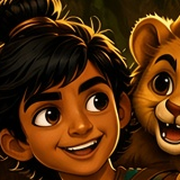
Myth vs. Story
Familiar Names, New Destinies
Many names in Ravan's Trial come from the Ramayana, one of India's oldest and best-loved epics. Here's how the book's versions compare with the traditional tellings.
Where the stories began
A grandmother, a mother, and a lot of stories
Sundar Nathan grew up in India hearing stories from the Ramayana and the Mahabharata, told by his grandmother Namagiri and his mother Saroja. Those stories were full of heroes, demons and magical creatures. He grew up to become an engineer in Silicon Valley, but he never stopped thinking about them.
When I was a boy in India, my grandmother Namagiri and my mother Saroja told me stories from the Ramayana and the Mahabharata. The Naraka Cycle grew out of those stories.
Sundar Nathan
How to use this page
The myth column sums up what most traditional tellings of the Ramayana and other old Indian stories say. There are hundreds of Ramayanas, told in many languages and regions, so details change from one telling to the next.
The story column is what happens in Ravan's Trial. It contains small spoilers up to the middle of the book, and they're marked.
“The story is gripping, familiar characters in new roles with new destinies.”
Viswanathan Anand, five-time World Chess Champion
Ravan
Ravana is the ten-headed king of Lanka and the great villain of the Ramayana, who carries off Sita. He is also remembered as a great scholar and a devoted worshipper of Shiva.
Ravan is a fifteen-year-old Asuran crown prince, years before any of that. He prays to Shiva, trains with a bow every day, and has to survive the Trial of Seven Days. His people are ruled by the conquering Devas.
Surpanakha
Ravana's sister. In the Ramayana, her meeting with Rama and Lakshmana in the forest, where Lakshmana cuts off her nose, helps set the great war in motion.
Surpanakha is a thirteen-year-old princess who plays the veena, sings healing raga-mantras, and flies into the jungle to rescue her brother. (Small spoiler: she ends up leading a quiet network of captives by learning all their names.)
Kumbhakarna
Ravana's giant brother, famous for an enormous appetite and for sleeping for months at a time because of a boon that went wrong.
The huge appetite is still there. But while Ravan is missing, fourteen-year-old Kumbhakarna sits in the Crown Temple in nine days of unbroken meditation, and says he found his brother “inside.”
Vibhishana
Ravana's younger brother, who advises him to return Sita and later joins Rama's side.
Vibishan is one year old. His big moment so far: escaping his nurse and crawling across the sacred floor of the Hall of Swaras.
Kaikesi
In many tellings, Kaikesi is Ravana's mother, the wife of the sage Vishrava.
Queen Kaikesi rules Asurapura while the king, Vish Rav, is away at war. She hides her missing children behind two empty chairs draped in saffron silk, and never lets the court see her fear.
Shukra, Prahasta and Akampana
Shukracharya is the guru of the Asuras. Prahasta is the commander of Ravana's army, and Akampana is one of the rakshasa warriors of Ravana's court.
Shukra is High Priest, royal guru and Surpanakha's music teacher. Prahasta commands Asurapura's forces. Akampana is Ravan's uncle, the Arch Blade Ranger, who trains the princess as well as the princes.
The Trimurti
The three great gods: Brahma the creator, Vishnu the protector and Shiva the destroyer.
The Prologue names them Brahma, who creates; Vaishnavi, who protects what is good; and Shiva, who destroys what is evil.
Brahma's children
Brahma's first sons, the four Kumaras, refuse to help him populate the world. He then creates the Prajapatis, and the seven great sages are the Saptarishis.
Same beginning: the perfect Kumaras politely decline. Then Brahma builds ten Prajapatis “limited” on purpose, so they can want, choose and surprise him. They make the peoples of Naraka.
Indra
King of the Devas and god of storms and rain. In the Rig Veda, his greatest victory is slaying the serpent Vritra.
Indra is the Chakravarthi, emperor of the Devas, who has conquered Naraka and works its people in secret mines. Vritra is one of the Prajapatis, the maker of the Nagas, who still pray to him.
Vishwakarma
The divine architect who builds the cities and weapons of the gods.
Vish Wa Karma, the Architect, is one of Indra's High Lords, and the one who dares to tell the emperor the truth. (Epilogue)
Asuras and Rakshasas
Asuras are the rivals of the Devas in many old stories. In the Ramayana, Ravana and his family are rakshasas.
They're two different peoples. Rakshasas are island giants who evolved on their own from clever hunting monkeys. The Asuras, Ravan's people, were made by the Prajapatis from Rakshasa strength and star-craft, and were denied the Vedas.
Vasuki and the Nagas
Vasuki is the great serpent king who is wrapped around Shiva's neck and who served as the rope when gods and asuras churned the ocean of milk. Nagas are divine serpent beings.
Vaasuki is a Naga girl, “nine feet of snake-tail and zero fear,” who wrestles Ravan in a secret school. Nagas can walk upright or flow as serpents, and their grandmothers run everything.
Sharabha and the simurgh
Sharabha is a fierce part-lion, part-bird form taken by Shiva. The simurgh is a giant, wise bird from Persian legend.
A simurgh is a lion-bodied, eagle-winged jungle beast. Ravan names the orphaned cub Sharabha after Shiva's winged form: “Part lion. Part bird.”
Vidyadharas and Kinnaras
Vidyadharas (“bearers of knowledge”) are magical sky beings linked with the Himalayas. Kinnaras are heavenly musicians, often shown as part human, part horse or bird.
Vidyadharas are the mountain singers of the Peaks who ride vyalas and hear Shakti's Song. Kinnaras are half rider and half horse, the Free Folk of the steppes, singing as they fight.
Naraka
In Hindu tradition, Naraka is a realm of punishment, often translated as “hell.”
Naraka is a hot, wild, living realm of jungles, peaks, steppes and red deserts, “hot as a furnace and twice as alive,” conquered by the Devas of Swarga.
Lanka
Ravana's island kingdom, often described as a city of gold.
Lanka is the home of Ravan's family, with the Rose Gate, moon-white palace towers and a Devan overseer watching the court.
Twice-born
Dvija, “twice-born,” traditionally describes someone who has gone through the sacred-thread ceremony and begun formal study.
An Asuran prince becomes twice-born by surviving seven days alone in the aranya. But the Teacher says the real test is bigger: taking the lives of others as your responsibility.